No products in the cart.

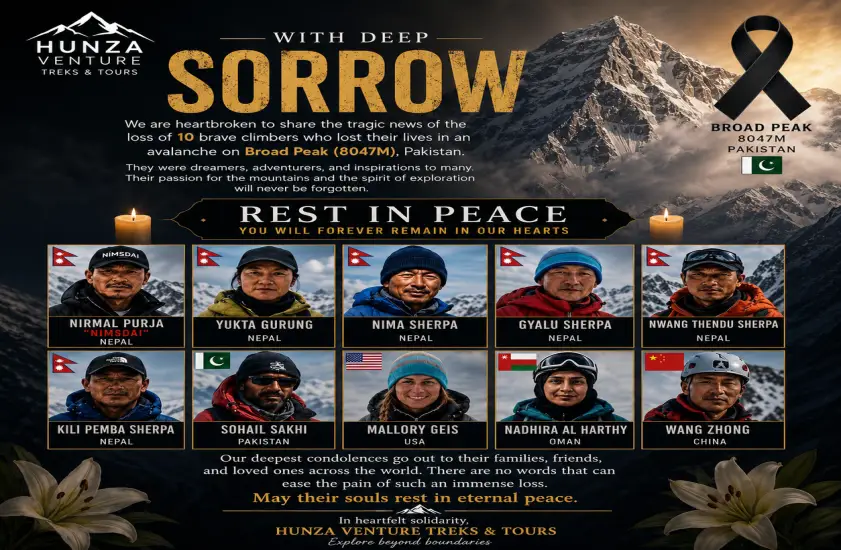
The towering peaks of Pakistan’s Karakoram Range have always inspired adventurers from around the world. Among these giants stands Broad Peak (8,051m), a magnificent mountain that symbolizes both breathtaking beauty and unforgiving power. Every climbing season, mountaineers leave behind the comfort of home to pursue a dream that few people truly understand a dream built on courage, sacrifice, discipline and an unwavering passion for the mountains.
The recent tragedy on Broad Peak, where an avalanche claimed the lives of an international expedition team, has deeply saddened the global mountaineering community. It serves as a heartbreaking reminder that even the world’s most experienced climbers cannot control the immense forces of nature. Rescue operations faced severe challenges due to weather, altitude, and the dangerous conditions of the mountain, highlighting just how difficult high-altitude expeditions can become.
For most people, an expedition begins at Base Camp. In reality, it begins years earlier.
Every successful climber has spent countless hours training their body and mind. They wake before sunrise for endurance runs, spend months carrying heavy backpacks, practice climbing techniques, learn rescue procedures and prepare themselves mentally for conditions where every decision can determine life or death.
Reaching an 8,000-meter mountain is not simply about physical strength. It requires patience, humility, teamwork and respect for nature.
Behind every summit photo lies years of dedication that often remain unseen.
Life on a high-altitude expedition is unlike anything experienced in everyday life.
Each day begins with freezing temperatures. Climbers melt snow to produce drinking water, ration food carefully, monitor changing weather forecasts and prepare equipment before moving higher on the mountain.
Simple tasks become exhausting above 6,000 meters. Walking a few dozen steps can leave even elite athletes breathless because oxygen levels decrease dramatically with altitude.
Every camp established on the mountain represents hours of physical effort. Climbers carry tents, ropes, fuel, food and emergency equipment while navigating glaciers, crevasses, steep ice slopes and avalanche-prone terrain.
Sleep is often interrupted by powerful winds shaking tents throughout the night.
Yet every morning they continue climbing.
Not because it is easy.
But because their dream is stronger than their discomfort.
Successful expeditions are never the achievement of one individual alone.
Behind every summit stands a remarkable team of guides, high-altitude porters, cooks, logistics coordinators, rescue personnel, helicopter crews and local communities.
Pakistan’s mountain guides and support teams work tirelessly in some of the harshest environments on Earth. They repeatedly risk their own lives to assist climbers from across the world.
When emergencies occur, these teams often become the first responders, searching dangerous terrain despite enormous personal risk.
Their courage deserves equal recognition.
Many people describe climbing as “conquering” a mountain.
Experienced mountaineers know differently.
No one conquers Broad Peak.
No one conquers K2.
No one conquers nature.
The mountain simply allows safe passage when conditions permit.
Avalanches, storms, falling rocks, hidden crevasses, and sudden weather changes can transform a safe route into an extremely dangerous environment within minutes. Even experienced climbers carefully monitor conditions, knowing that turning back can be the wisest decision.
True mountaineering is built on respect, not ego.
People often ask a simple question after every mountain tragedy:
“Why do they keep climbing?”
The answer cannot be measured by statistics or explained in a single sentence.
For climbers, mountains represent freedom.
They represent self-discovery.
They represent the pursuit of becoming stronger, not only physically, but mentally and emotionally.
Standing beneath an 8,000-meter peak reminds every human being how small we truly are.
Many climbers say that the mountains teach lessons no classroom ever could:
These lessons remain long after the expedition ends.
When a climber reaches the summit, they are never alone.
Their success belongs to everyone who helped them along the journey, their families waiting at home, teammates climbing beside them, guides fixing ropes, porters carrying equipment, cooks preparing meals, rescue teams standing ready and local communities supporting the expedition from beginning to end.
Mountaineering is one of the world’s greatest examples of international cooperation.
People from different countries, languages, cultures and beliefs unite with one shared purpose.
The mountain treats everyone equally.
The climbers who lost their lives on Broad Peak came from different parts of the world, but they shared the same passion for exploration and the same respect for the mountains.
Their journey reminds us that mountaineering is not only about reaching the highest point on Earth.
It is about courage in uncertainty.
It is about perseverance through hardship.
It is about inspiring others to dream bigger while always respecting the power of nature.
Their legacy will continue to inspire future generations of climbers who choose preparation over haste, teamwork over ego and wisdom over pride.
At Hunza Venture, we have the privilege of working in one of the most extraordinary mountain regions on Earth.
Every expedition reminds us that mountains are not merely destinations, they are powerful teachers.
We extend our deepest condolences to the families, friends, teammates, guides and every member of the international mountaineering community affected by the Broad Peak tragedy.
May we continue exploring these magnificent mountains with humility, responsibility and respect.
Because in the end, the greatest achievement is not simply reaching the summit.
It is returning home safely, carrying with us the lessons the mountains have shared.
“The mountains are not our challenge. They simply reveal who we truly are.”
According to the latest confirmations from the Alpine Club of Pakistan and international rescue authorities, the following ten expedition members tragically lost their lives in the Broad Peak avalanche of 30 July 2026:
| Name | Nationality |
|---|---|
| Nirmal Purja ~ Nimsdai | Nepal |
| Nathira Ahmed Abdullah Al Harthy | Oman |
| Mallory Geis | United States |
| Pur Bahadur Gurung | Nepal |
| Wang Zhong | China |
| Nima Sherpa | Nepal |
| Kili Pemba Sherpa | Nepal |
| Sohail Sakhi | Pakistan |
| Yukta Gurung | Nepal |
| Gyalu Sherpa | Nepal |


Explore Beyond Boundaries

