No products in the cart.

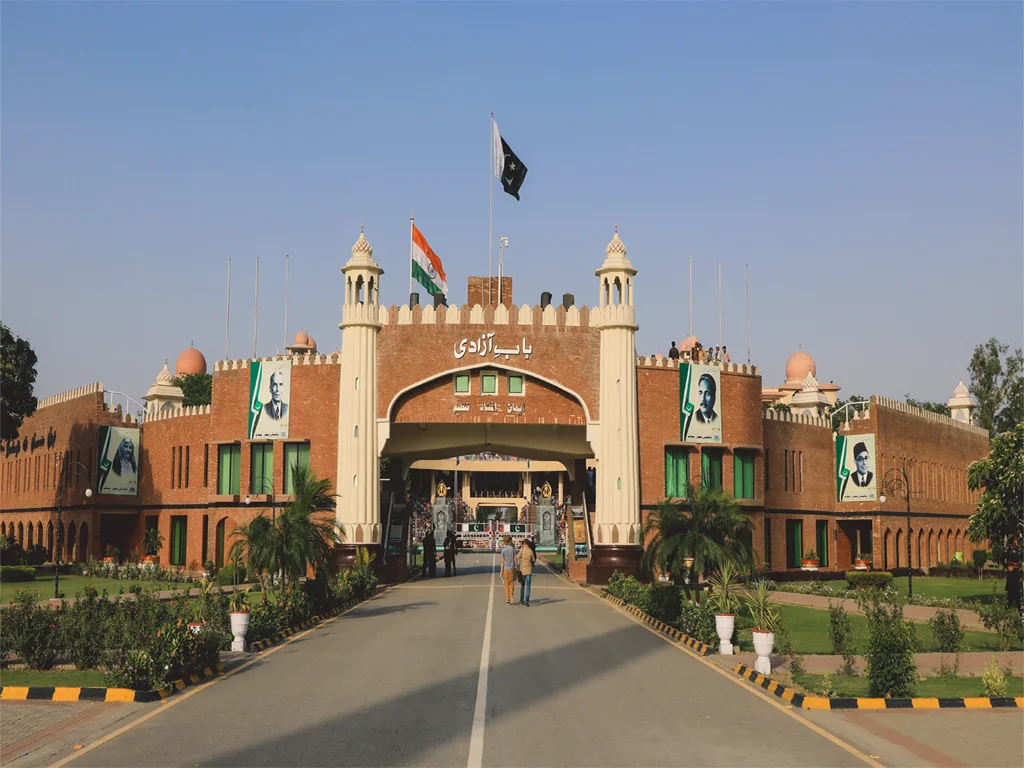
When people think about the most memorable places to visit in Lahore, they often picture the Badshahi Mosque, Lahore Fort, Walled City and the lively streets of the old city. But beyond these historic landmarks lies another destination that offers a completely different experience: Wagah Gate Lahore.
Located near the Pakistan-India border, Wagah is famous around the world for its spectacular evening flag-lowering ceremony. Here, history, national pride, military tradition and the energy of a cheering crowd come together in a setting unlike anywhere else in Pakistan.
For international travelers, visiting Wagah Border is not simply about watching a parade. It is an opportunity to experience an important part of Pakistan’s modern history and understand the emotions connected with the country’s eastern frontier.
Wagah is located in the Lahore District of Punjab, close to the international border between Pakistan and India. The border lies along the historic Grand Trunk Road, one of South Asia’s oldest and most important road routes.
The Wagah side is in Pakistan, while Attari is the corresponding settlement on the Indian side. Lahore is roughly 25–30 kilometers from the border, making Wagah an easy addition to a Lahore sightseeing itinerary.
The location also carries enormous historical importance. Following the Partition of British India in 1947, this area became one of the major crossing points between the newly created countries of Pakistan and India.
The main attraction at Wagah Gate is the flag-lowering ceremony, commonly known as the Wagah Border ceremony or Beating Retreat ceremony.
The tradition dates back to 1959 and has developed into one of the most recognizable ceremonial events associated with the Pakistan-India border. Every evening, crowds gather on both sides to watch the Pakistan Rangers and India’s Border Security Force perform a carefully coordinated military drill before the flags are lowered at sunset.
The atmosphere begins building well before the main ceremony. Visitors fill the grandstands, national flags appear throughout the crowd and patriotic songs and chants create an energetic atmosphere.
As the ceremony begins, the guards march towards the border gate with highly disciplined movements. The dramatic high steps, precise formations and ceremonial gestures have made the event particularly popular with visitors.
At the conclusion, the flags of Pakistan and India are lowered, folded and the border gates are closed for the night. The ceremony represents the complicated relationship between the two neighboring countries one shaped by shared history, national identity, rivalry and cultural connections.
What makes Wagah Gate fascinating is the contrast between its location and its atmosphere.
A border normally represents separation. At Wagah, however, the border has also become a place where thousands of people gather to share a public experience.
For visitors, the ceremony offers an opportunity to see how national identity is expressed through music, flags, military discipline and public participation. The crowd is an important part of the experience. Children wave Pakistani flags, families cheer from the stands and visitors often find themselves caught up in the excitement of the occasion.
The event has also evolved over the years, with some of the more aggressive elements of the traditional performance being toned down.
Wagah’s importance goes far beyond the evening ceremony.
The border is closely connected with the events of Partition in 1947, when British India was divided into Pakistan and India. Millions of people moved across the newly established boundary, and Punjab was one of the regions most deeply affected by the upheaval.
The Wagah crossing therefore stands on a landscape that carries memories of migration, separation and the creation of two independent nations.
The border is also located on the historic Grand Trunk Road, connecting major parts of the Indian subcontinent. This road has played an important role in trade, travel and communication for centuries.
For travelers interested in the history of Pakistan, Wagah provides an opportunity to see how a geographical boundary became an important part of the country’s national story.
A visit to Wagah Gate usually begins with the journey from Lahore towards the border. As you approach Wagah, the urban landscape gradually gives way to the border area.
Inside the visitor area, you can expect a lively atmosphere, particularly as the ceremony approaches. The crowd becomes increasingly energetic, and the sound of patriotic songs and chants fills the surroundings.
The ceremony itself is highly organized. The soldiers’ synchronized movements, impressive marching style and the final lowering of the flags provide the main spectacle.
For many visitors, the most memorable part is not a single moment but the atmosphere created by thousands of people watching the ceremony together.
The main ceremony takes place around sunset, but the exact schedule can vary because the event is linked to sunset and operational conditions.
If Wagah Border is included in your Lahore sightseeing tour, it is advisable to reach the venue well before the ceremony begins. Arriving early gives you more time to pass through security, find your seating area and enjoy the atmosphere before the main event.
During weekends, public holidays and special national occasions, the area can become particularly busy.
Travelers should also confirm the latest local arrangements before visiting, as access, ceremony timings and security procedures can change.
Wagah Border is a sensitive international border, so visitors should follow the instructions of security personnel throughout their visit.
A few simple points can make the experience more comfortable:
Because Wagah is an active international border, conditions are not always the same as those at an ordinary tourist attraction.
Wagah Border can easily be combined with other major attractions in Lahore.
A well planned Lahore sightseeing tour might include the Lahore Fort, Badshahi Mosque, Wazir Khan Mosque, Minar-e-Pakistan, Lahore Museum and the historic Walled City, followed by a journey towards Wagah in the afternoon.
This combination allows travelers to experience different sides of Lahore in a single day from Mughal architecture and centuries-old cultural heritage to the modern history and national identity represented by Wagah.
For international visitors, the contrast can be particularly interesting. Lahore’s historic monuments tell the story of the city’s ancient and Mughal past, while Wagah reflects a much more recent chapter in the history of the region.
There are many reasons to include Wagah Gate in a Pakistan travel itinerary.
Historical significance: Wagah is closely connected with the Partition of 1947 and the history of Pakistan and India.
Unique experience: Few tourist attractions offer the opportunity to watch a formal ceremony at an international border.
Cultural experience: The crowd, flags, music and patriotic atmosphere provide a glimpse into contemporary Pakistani culture.
Military tradition: The precision and discipline of the Pakistan Rangers make the ceremony visually impressive.
Wagah Gate is more than a line separating two countries. It is a place where history and the present meet every evening.
Easy from Lahore: Its location near Lahore makes it suitable for a half-day or afternoon excursion as part of a wider Lahore tour.
Standing among the crowd and watching the flags being lowered as the sun sets creates a strong sense of occasion. The ceremony reflects the complicated relationship between Pakistan and India, but it also reminds visitors of the shared history, geography and cultural heritage of the people on both sides of the border.
For anyone exploring Lahore, a visit to Wagah Gate offers something very different from the city’s famous monuments. It is energetic, emotional and deeply connected with the story of modern Pakistan.
If you are planning a Lahore city tour or a wider Pakistan sightseeing journey, adding Wagah Gate to your itinerary can make your visit to Lahore considerably more memorable.
Hunza Venture


Explore Beyond Boundaries

